

In today’s highly competitive automotive landscape, building direct, lasting relationships with customers is no longer a luxury—it’s a necessity.
While digital advertising casts a wide net, email marketing provides the precision tool needed to nurture leads, drive service appointments, and foster loyalty throughout the entire vehicle ownership lifecycle.
It’s a direct line to your customer’s inbox, offering a platform for personalized communication that builds trust and delivers measurable results.
When executed strategically, email marketing becomes a powerful engine for sustainable growth, capable of generating significant returns on investment.
Importance of Automotive Email Marketing in the Automotive Industry
Email marketing remains one of the most effective and profitable channels for the automotive industry.
It allows dealerships and service centers to bypass the noise of social media algorithms and speak directly to their audience.
With 88% of potential car buyers conducting online research before purchases, a robust email strategy is essential to capture and nurture these digitally-savvy prospects.
Furthermore, email excels at customer retention, a critical component of dealership profitability.
By maintaining consistent communication, you can guide customers from their first vehicle purchase through years of service appointments and, ultimately, to their next vehicle trade-in, maximizing customer lifetime value.
For the automotive aftermarket, the financial incentive is clear, with email marketing showing an average ROI of 420%.
Understanding Your Automotive Email Marketing Audience
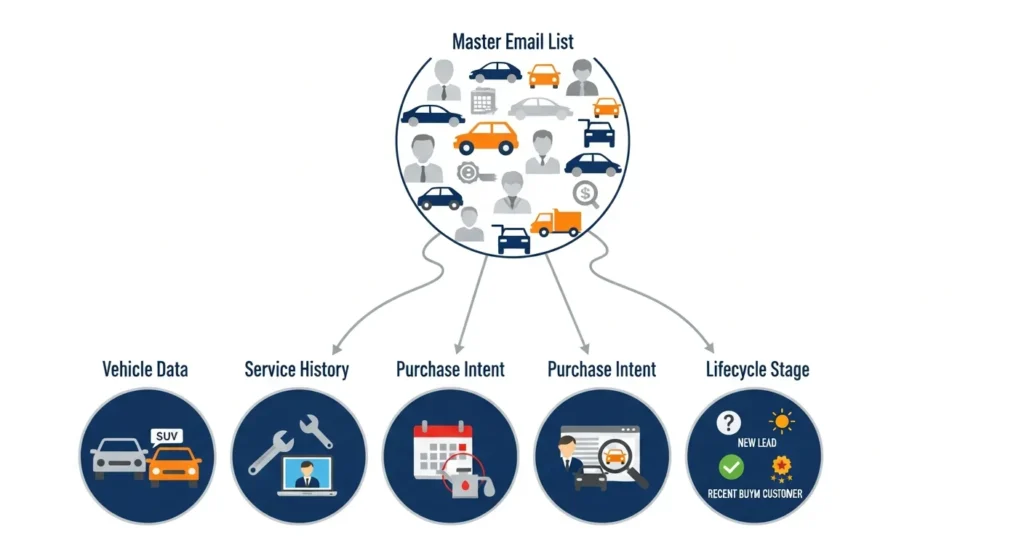
Advanced segmentation uses customer data to create highly targeted email lists.
Effective email marketing begins with a deep understanding of your audience.
Generic, one-size-fits-all campaigns are ineffective.
The key is segmentation—dividing your master email list into smaller, more targeted groups based on shared characteristics.
Basic segmentation might include demographics like location or age.
However, for the automotive industry, advanced segmentation is where the real power lies.
You can create highly relevant campaigns by segmenting based on vehicle data (make, model, year), service history (last service date, type of service), purchase intent (website behavior, leads submitted), and customer lifecycle stage (new lead, recent buyer, long-term service customer).
This granular approach ensures that every email resonates with the recipient’s specific needs and interests.
Systeme.io Email Marketing
- Unlimited email sending capabilities
- Easily build landing pages & funnels
- Automation & marketing tools included
- Perfect for beginners & entrepreneurs
CRM Integration for Automotive Email Marketing Automation
Your Customer Relationship Management (CRM) or Dealer Management System (DMS) is the heart of your customer data.
Integrating it with your email marketing platform is non-negotiable for achieving sophisticated automation and personalization.
This integration allows for the seamless flow of data, enabling you to trigger automated email workflows based on real-time customer actions.
For example, when a sale is logged in the CRM, a post-purchase welcome series can be automatically initiated.
When a service appointment is completed, a follow-up email requesting a review can be sent.
This connection transforms your email marketing from a manual, batch-and-blast operation into a responsive, automated system that nurtures customers at every touchpoint.
Tracking Automotive Email Marketing Performance Metrics
To optimize your email strategy, you must measure what matters. While vanity metrics have their place, focus on performance indicators that directly impact your business goals. Key metrics to track include:
- Open Rate: The percentage of recipients who opened your email. The average for the automotive sector is 12.6%, providing a useful benchmark.
- Click-Through Rate (CTR): The percentage of recipients who clicked on a link within your email. This measures engagement with your content.
- Conversion Rate: The percentage of recipients who completed a desired action, such as booking a service appointment or scheduling a test drive.
- Unsubscribe Rate: The percentage of users who opt out. A high rate may indicate irrelevant content or excessive frequency.
By analyzing these metrics, you can identify which campaigns are succeeding and which need refinement, allowing for continuous, data-driven improvement.
Systeme.io Email Marketing
- Unlimited email sending capabilities
- Easily build landing pages & funnels
- Automation & marketing tools included
- Perfect for beginners & entrepreneurs
Welcome Series for Automotive Email Marketing Success
The first impression is critical.
A welcome email series, triggered immediately after a new subscriber joins your list, is your opportunity to set the stage for a positive relationship.
This automated sequence should do more than just say “thanks for signing up.”
Use it to introduce your dealership’s values, highlight key services, introduce the service team, and provide valuable information, such as maintenance tips or links to your new and used inventory.
A well-crafted welcome series boasts significantly higher open rates than standard campaigns and is essential for converting a new subscriber into an engaged and loyal customer.
Systeme.io Email Marketing
- Unlimited email sending capabilities
- Easily build landing pages & funnels
- Automation & marketing tools included
- Perfect for beginners & entrepreneurs
Personalization Strategies in Automotive Email Marketing
Personalization in automotive email marketing goes far beyond using the customer’s first name.
True personalization leverages the rich data in your CRM to deliver hyper-relevant content.
Imagine an email that not only addresses the customer by name but also references their specific vehicle (“Your 2022 Honda CR-V”). You can use dynamic content blocks to show service specials relevant only to that model or display inventory that matches their previous browsing history.
This level of detail demonstrates that you understand your customer’s individual needs, fostering a stronger connection and dramatically increasing the likelihood of conversion.
Systeme.io Email Marketing
- Unlimited email sending capabilities
- Easily build landing pages & funnels
- Automation & marketing tools included
- Perfect for beginners & entrepreneurs
Service Reminder Emails for Automotive Customer Retention
Service reminder emails are a cornerstone of customer retention for any dealership or repair shop.
They are a perfect example of proactive, valuable communication.
By integrating with your DMS, you can automate reminders based on manufacturer-recommended service intervals, time since the last visit, or specific mileage milestones.
These emails should be helpful, not just promotional.
Include the customer’s vehicle information, clearly state the recommended service, and provide a simple, one-click call-to-action to book an appointment online.
This automated system keeps your service bays full with predictable revenue and reinforces your dealership as a trusted partner in vehicle maintenance.
Systeme.io Email Marketing
- Unlimited email sending capabilities
- Easily build landing pages & funnels
- Automation & marketing tools included
- Perfect for beginners & entrepreneurs
Mobile-Responsive Automotive Email Marketing Design
The majority of emails are now opened on a mobile device.
If your emails are not designed for a small screen, you are creating a poor user experience and sacrificing potential revenue.
Mobile-responsive design is essential.
This means using a single-column layout that is easy to scroll, employing large, legible fonts, ensuring images load quickly, and designing call-to-action buttons that are large enough to be easily tapped with a thumb.
Before sending any campaign, test it across multiple devices and email clients to ensure it renders perfectly for every recipient, regardless of how they access their inbox.
Systeme.io Email Marketing
- Unlimited email sending capabilities
- Easily build landing pages & funnels
- Automation & marketing tools included
- Perfect for beginners & entrepreneurs
Writing High-Impact Subject Lines for Automotive Email Marketing
The subject line is your email’s first and often only chance to make an impression.
It must be compelling enough to cut through a crowded inbox and earn an open. For automotive marketing, specificity and value are key.
Instead of a generic “Service Specials,” try “Save 15% on Your Toyota’s Next Oil Change.”
Create a sense of urgency with phrases like “Limited Time Offer” or “Your Offer Expires Friday.”
Personalization can also be highly effective, such as “John, Is Your Ford F-150 Ready for Winter?” A/B test different subject lines to learn what resonates most with your audience.
Systeme.io Email Marketing
- Unlimited email sending capabilities
- Easily build landing pages & funnels
- Automation & marketing tools included
- Perfect for beginners & entrepreneurs
Reducing Operational Costs with Automotive Email Marketing Automation
Automation doesn’t just improve marketing effectiveness; it also drives operational efficiency.
Consider the manual labor involved in phone calls for appointment confirmations or service reminders.
An automated email sequence can handle these tasks reliably and at a fraction of the cost, freeing up your service advisors or BDC agents to focus on more complex customer interactions and revenue-generating activities.
By automating routine communications, from lead follow-ups to post-service surveys, you reduce labor costs, minimize human error, and ensure a consistent communication standard for every customer.
Systeme.io Email Marketing
- Unlimited email sending capabilities
- Easily build landing pages & funnels
- Automation & marketing tools included
- Perfect for beginners & entrepreneurs
Building Brand Awareness Through Automotive Email Marketing Campaigns
Email marketing is a powerful tool for building and reinforcing your brand identity.
Beyond promotions and service reminders, use email to deliver valuable content that positions your dealership as a trusted automotive authority.
Send out monthly newsletters with articles on vehicle maintenance tips, safety features on new models, or guides to local scenic drives.
This content marketing approach builds top-of-mind awareness.
When a customer is ready for their next service or vehicle purchase, your dealership—the one that has been consistently providing helpful information—will be the first one they think of.
Systeme.io Email Marketing
- Unlimited email sending capabilities
- Easily build landing pages & funnels
- Automation & marketing tools included
- Perfect for beginners & entrepreneurs
Automotive Email Marketing Compliance and Regulations
Maintaining trust is paramount, and that includes respecting privacy and adhering to legal regulations.
Key regulations like the CAN-SPAM Act in the U.S. and GDPR in Europe set clear rules for commercial email.
Essential compliance steps include obtaining clear consent before adding someone to your list, providing a clear and easy way to unsubscribe in every email, and promptly honoring all opt-out requests.
Adherence to these laws not only avoids potential legal penalties but also protects your sending reputation, ensuring your emails have the best chance of landing in the inbox.
Systeme.io Email Marketing
- Unlimited email sending capabilities
- Easily build landing pages & funnels
- Automation & marketing tools included
- Perfect for beginners & entrepreneurs
Managing and Maintaining a Clean Automotive Email Marketing List
The quality of your email list is more important than its quantity.
A large list filled with inactive or invalid addresses will lead to low open rates, high bounce rates, and can damage your sender reputation, increasing the likelihood your emails are marked as spam.
Regularly practice list hygiene by removing subscribers who haven’t engaged with your emails in a set period (e.g., 6-12 months).
Before removing them, you can attempt a final re-engagement campaign. A clean, engaged list results in better deliverability, more accurate performance metrics, and a higher return on investment.
Systeme.io Email Marketing
- Unlimited email sending capabilities
- Easily build landing pages & funnels
- Automation & marketing tools included
- Perfect for beginners & entrepreneurs
Best Send Times for Automotive Email Marketing Campaigns
While numerous studies suggest optimal send times, there is no universal “best time” to send an email.
The ideal time depends entirely on your specific audience’s habits.
General wisdom often points to mid-week mornings or evenings when people are checking personal emails.
However, an automotive audience might be more responsive on a Saturday morning when planning their weekend errands, including a potential dealership visit.
The only way to know for sure is to test.
Send your campaigns at different times and on different days of the week, then analyze your performance data to identify the unique sending windows that yield the highest engagement for your subscribers.
Systeme.io Email Marketing
- Unlimited email sending capabilities
- Easily build landing pages & funnels
- Automation & marketing tools included
- Perfect for beginners & entrepreneurs
Revenue Growth Tips Using Automotive Email Marketing Strategies
Email marketing is a direct driver of revenue growth.
To maximize its impact, focus on strategic upselling and cross-selling opportunities.
When a customer books a specific service, your confirmation email can suggest a relevant add-on, like a tire rotation with an oil change.
Use post-purchase emails to promote high-margin accessories tailored to the vehicle they just bought.
For customers nearing the end of their loan or lease term, deploy a targeted campaign showcasing new models and personalized trade-in offers.
By leveraging customer data to present timely, relevant offers, email transforms from a communication tool into a consistent revenue-generating machine.
Systeme.io Email Marketing
- Unlimited email sending capabilities
- Easily build landing pages & funnels
- Automation & marketing tools included
- Perfect for beginners & entrepreneurs
Conclusion
Mastering automotive email marketing is a strategic imperative for any dealership or service center aiming for long-term success.
It is far more than sending occasional promotions; it is about building a scalable, data-driven communication engine that engages customers at every stage of their ownership journey.
By focusing on a foundation of clean data integrated with your CRM, you can unlock the power of advanced segmentation and automation.
The path to success lies in delivering personalized, relevant, and timely messages—from the initial welcome series to proactive service reminders and targeted sales campaigns.
Always prioritize a mobile-first design, craft compelling subject lines, and meticulously track your performance metrics to continuously refine your approach.
By embracing these principles, you can transform your email program from a simple marketing channel into a cornerstone of customer retention, brand loyalty, and significant revenue growth.

Send Unlimited Emails for Free
Build landing pages, email campaigns, and complete sales funnels — all in one simple platform.

Pasive Marketer is a digital publication dedicated to AI tools, SaaS software, digital marketing, and online business growth. We create in-depth reviews, comparisons, tutorials, and expert guides to help entrepreneurs, marketers, and businesses discover the best software solutions and make informed purchasing decisions.